Hello everyone! Today, I want to dive deep into a staple of our dining tables that has now captured the hearts (and taste buds) of people all over the world: Korean Gim (Dried Seaweed). Often referred to as the "Black Semiconductor" for its immense economic value, Korean Gim is more than just a delicious side dish—it’s a global superfood that is even helping to protect our planet.
1. A Name Born from a Surname: Why is it called 'Gim'?
Have you ever wondered why this seaweed is called "Gim" in Korea? The name actually has a fascinating origin linked to a specific family name.
During the reign of King Injo of the Joseon Dynasty (around 1640), a man named Gim Yeo-ik (김여익) moved to Taein Island in Gwangyang, South Jeolla Province, to escape the chaos of the Manchu Innovation. While there, he noticed seaweed drifting in the ocean and getting caught on fallen branches. This inspired him to devise the world's first systematic seaweed farming method using bamboo and oak sticks.
As this "sea cloth" became popular in local markets, people began asking for its name. Since it was produced by "the Gim family from Gwangyang," it naturally became known as "Gim." Historical records suggest that King Injo himself was so impressed by its taste that he officially bestowed the name "Gim," after Gim Yeo-ik’s surname, forever replacing older terms like haeu (sea clothes).
2. How Long Have Koreans Been Eating Gim?
The history of Koreans consuming seaweed goes back much further than the 17th century.
- The Three Kingdoms Period: Records in the Samguk Yusa (Memorabilia of the Three Kingdoms) indicate that seaweed was consumed as far back as the Silla Dynasty.
- The Goryeo Dynasty: There was a tradition of eating 'Boksam' (Luck Wraps) during the First Full Moon of the year. People would wrap rice in wide leaves or seaweed to symbolize "wrapping up good fortune." This is widely considered the ancestor of the modern Gimbap.
- The Joseon Dynasty: Gim was frequently listed as a royal tribute in major geographical texts like the Sejong Sillok Jiriji, highlighting its status as a highly valued ingredient.
3. The "Blue Carbon" Hero: A Natural Purifier for the Planet
In recent years, Korean Gim has gained international acclaim not just for its flavor, but for its environmental value. Seaweed farms act as "Carbon Sponges" for the ocean, making them a crucial tool in the fight against climate change.
- Carbon Sequestration: Through photosynthesis, Gim absorbs vast amounts of carbon dioxide and releases oxygen. This is known as 'Blue Carbon'—carbon captured by ocean ecosystems. Remarkably, seaweed can sequester carbon at a rate much higher than terrestrial forests per unit area.
- Water Purification: As it grows, Gim absorbs excess nutrients like nitrogen and phosphorus from the sea, acting as a natural filter that prevents harmful algal blooms and maintains water quality.
- A Global Misconception: In fact, some environmentally conscious consumers in North America and Europe have the charming misconception that "Korea creates massive underwater forests to save the planet and eats the byproduct (Gim) as a snack." While we eat it because it's delicious, the environmental benefit is a massive win-win for the world.
4. Commanding 80% of the Global Market: The "Black Semiconductor"
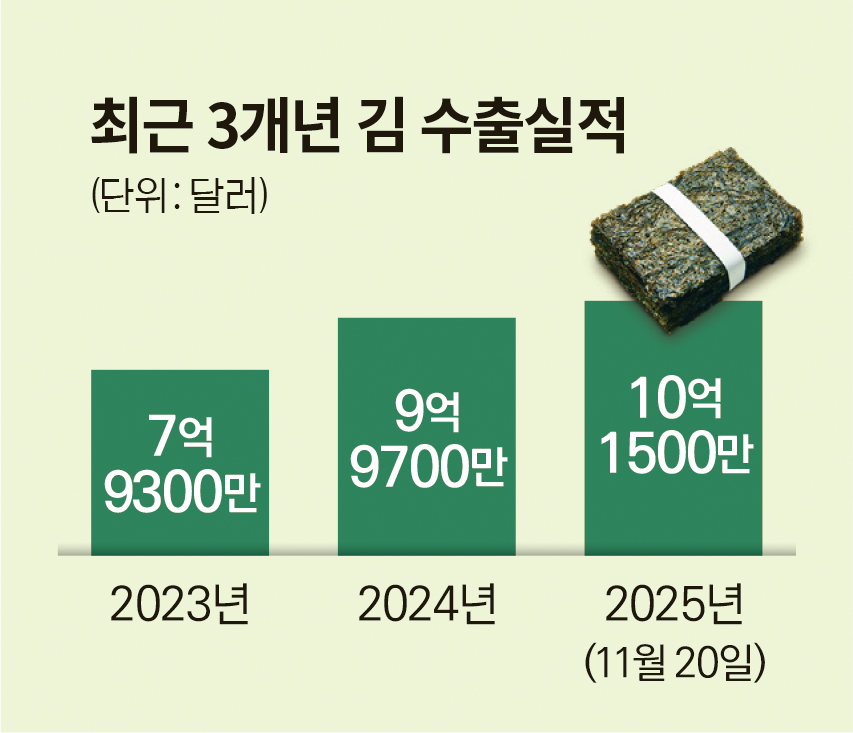
South Korea is the undisputed leader in the global seaweed market. As of 2026, Korean Gim accounts for roughly 80% of the world's export market.
| Category | Key Insight |
| Global Standing | Exported to over 120 countries; undisputed #1 market share |
| Export Value | The first agricultural/fishery product to surpass $1 billion in annual exports |
| Global Perception | Recognized as a "Healthy Vegan Snack" (a best-seller in major US retailers like Costco) |
The days of Westerners hesitantly calling it 'black paper' are over. Today, it is a trendy, low-calorie, high-protein snack that replaces potato chips. The crispy texture and savory aroma of Korean-style roasted Gim are competitive advantages that no other country has been able to replicate.
5. Closing Thoughts
Every sheet of Gim we enjoy today carries the 400-year-old wisdom of Gim Yeo-ik and the silent effort of the ocean to cool down our warming planet. Tonight, why not wrap a spoonful of warm rice in a piece of Gim and enjoy a taste of "good fortune"?
Your comments and likes give this blog great strength!
'Taste of Korea' 카테고리의 다른 글
| Why Koreans Are the "Nation of Spices": The Science and Culture of Heat (0) | 2026.04.27 |
|---|---|
| Must-Try Korean Snacks from Daiso: Best Treats Under $2! (0) | 2026.04.13 |