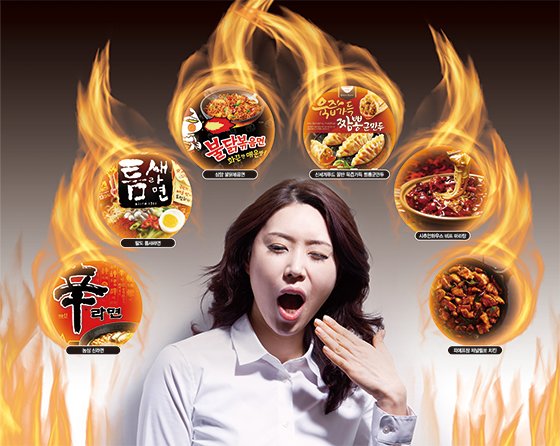
Have you ever wondered why that bowl of Shin Ramyun you had yesterday felt a bit "tame" compared to how you remember it as a child? You aren't alone. In Korea, there is a common saying that our national palate is "evolving" (or perhaps "desensitized") at an incredible speed. While the actual spice levels of famous instant noodles have increased over the decades, the Korean public constantly demands something hotter, bolder, and more extreme. But why are we so obsessed with this "painful" pleasure?
The Paradox of Adaptation
The Korean people are known for their incredible speed of adaptation. Whether it’s the rapid growth of technology or the shifting trends in pop culture, once a new standard is set, we adjust to it almost instantly. The same principle applies to our taste buds. When Buldak Bokkeum Myeon (Fire Chicken Noodles) first hit the shelves, it was a shock to the system—a level of heat that seemed impossible to enjoy. Fast forward to today, and for many, it has become a standard meal. This rapid adaptation has led to a "spice inflation," where food manufacturers must continuously push the boundaries of the Scoville scale just to keep the "Nation of Spices" satisfied.
Happiness Hidden in Pain
Biologically, spiciness is not a flavor; it is a sensation of pain. When the capsaicin hits our receptors, our brain perceives it as a physical threat and releases endorphins—the body’s natural painkillers—to counteract the "stress." This results in a sense of euphoria and clarity often referred to as a "spice high." In a fast-paced, high-pressure society like Korea, a bowl of burning hot noodles provides a quick, affordable, and legal way to wash away daily stress through a burst of endorphins. It is a survival strategy turned into a culinary preference.
From Local Habit to Global Entertainment
What used to be a local habit has now become a global phenomenon. Thanks to platforms like TikTok and YouTube, the "Fire Noodle Challenge" turned a painful meal into a competitive sport. For foreigners, watching a Korean person calmly finish a bowl of fire noodles is a source of awe and confusion. They ask, "How can you eat that?" But for us, it’s an invitation to join the fun.
The export of these spicy products continues to skyrocket because they offer more than just calories; they offer an experience. It is a digital-age badge of honor. When a creator in New York or London finishes a spicy challenge, they aren't just eating; they are participating in a global K-Culture ritual.
Conclusion: A Dynamic Palate for a Dynamic Nation
The reason we keep seeking stronger heat is a reflection of the Korean spirit: never settling, always adapting, and finding joy even in the midst of intensity. We don’t just eat spicy food to fill our stomachs; we eat it to feel alive, to bond with others over a shared challenge, and to prove that we can handle whatever heat life throws our way.
So, the next time you reach for that extra packet of spicy sauce, remember—you aren't just seasoning your noodles. You are participating in a grand tradition of a nation that turns pain into a celebration.
'Taste of Korea' 카테고리의 다른 글
| The "Black Semiconductor" Saving the Earth: The Origins and Global Rise of Korean Gim (1) | 2026.04.16 |
|---|---|
| Must-Try Korean Snacks from Daiso: Best Treats Under $2! (0) | 2026.04.13 |